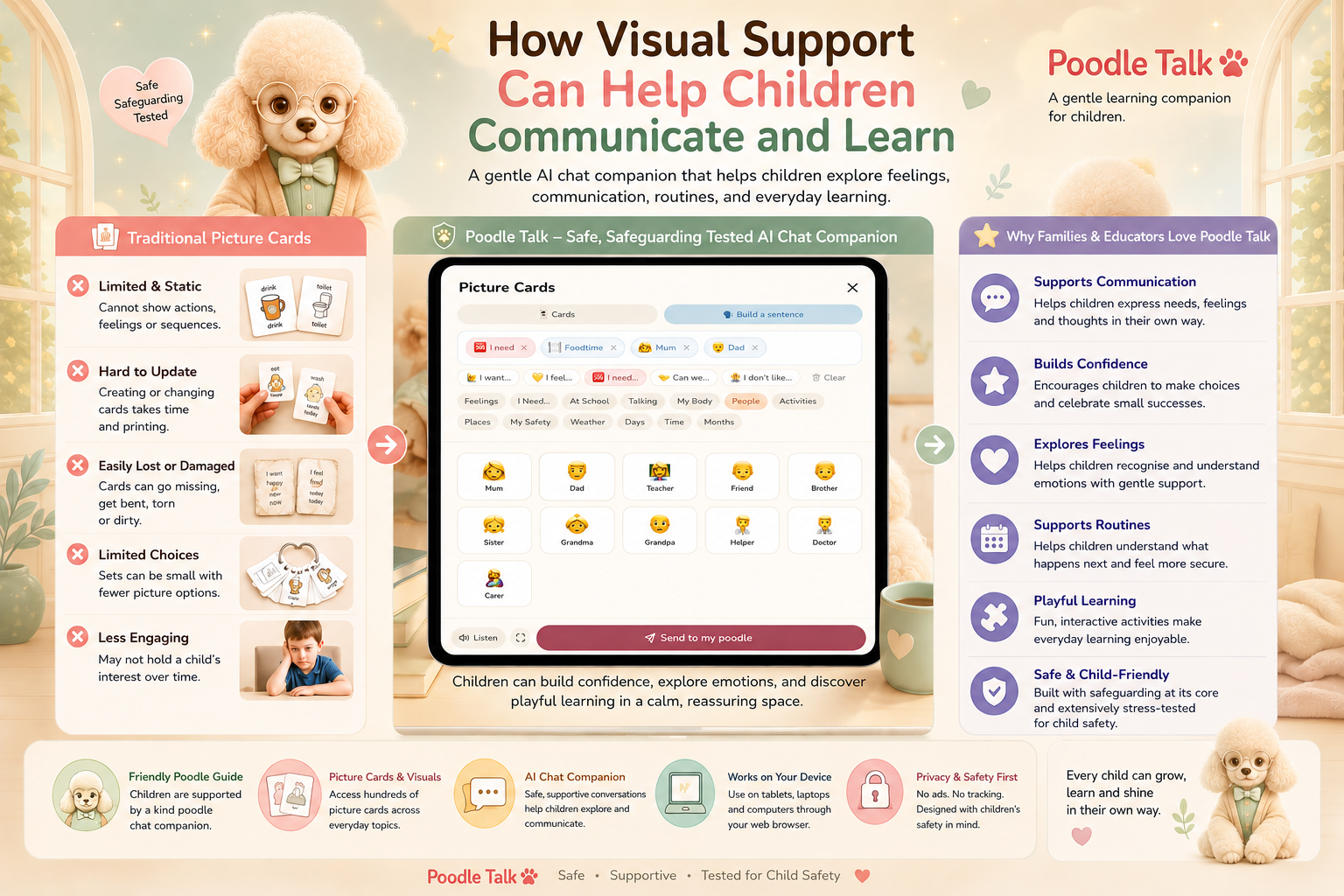
Why Schools Need More Than Traditional Picture Cards
For many years, picture cards have played an important role in helping children communicate, understand routines and express their needs. In schools, nurseries and specialist settings, visual supports have helped thousands of children build confidence and reduce frustration.
Picture cards are simple, familiar and often very effective.
However, today's children are growing up in a digital world, and many school environments are becoming increasingly complex. While traditional picture cards still have value, there are now opportunities to provide children with more flexible, personalised and accessible communication tools.
The Challenges of Traditional Picture Cards
Many schools continue to rely on printed picture cards, communication boards and laminated visual supports.
These can be helpful, but they often come with practical challenges:
Cards can become lost, damaged or misplaced.
Updating visuals requires printing, cutting and laminating.
Large sets of cards can become difficult to organise.
Children may outgrow limited vocabulary options.
Staff may spend significant time maintaining resources.
Visuals may not easily transfer between home and school.
For some children, these challenges can create barriers to communication rather than removing them.
How Digital Visual Support Can Help
A well-designed visual communication app allows children to access support whenever they need it.
Instead of searching through folders or carrying large sets of cards, children can access communication tools from a tablet or device.
Digital visual supports can offer:
Larger vocabulary choices.
Personalised images and routines.
Consistent support across different classrooms.
Easy updates without printing.
Visual schedules and step-by-step instructions.
Support for communication, emotions and learning activities.
Most importantly, the child's communication tools can grow alongside their needs.
Supporting Independence
One of the biggest benefits of digital visual support is independence.
Many children want to communicate without relying on an adult to locate the correct card or prepare resources.
A visual support app can help children:
Make choices independently.
Express feelings.
Request help.
Follow routines.
Build confidence in communication.
Small moments of independence can make a significant difference to a child's day.
Supporting Staff and Families
Digital tools can also help teachers, teaching assistants and families.
When visual supports are stored in one place, staff can spend less time preparing resources and more time supporting children.
Families can use similar visuals at home, creating greater consistency between school and home environments.
This can reduce anxiety and help children understand expectations more clearly.
Technology Should Support, Not Replace
Traditional picture cards still have an important place in education.
The goal is not to replace every visual support tool.
Instead, technology should provide additional options that help schools meet the diverse needs of children.
Every child communicates differently.
Some children may prefer physical cards.
Others may engage more effectively with interactive digital supports.
The most important thing is ensuring that every child has access to tools that help them communicate, participate and feel understood.
Looking Forward
Children today deserve communication tools that reflect the world they live in.
By combining proven visual support approaches with modern technology, schools can create more flexible, engaging and accessible environments for all learners.
Every child deserves a voice.
Every child deserves to be understood.
And every child deserves communication tools that help them succeed.
— L C
Creator of Poodles & Friends