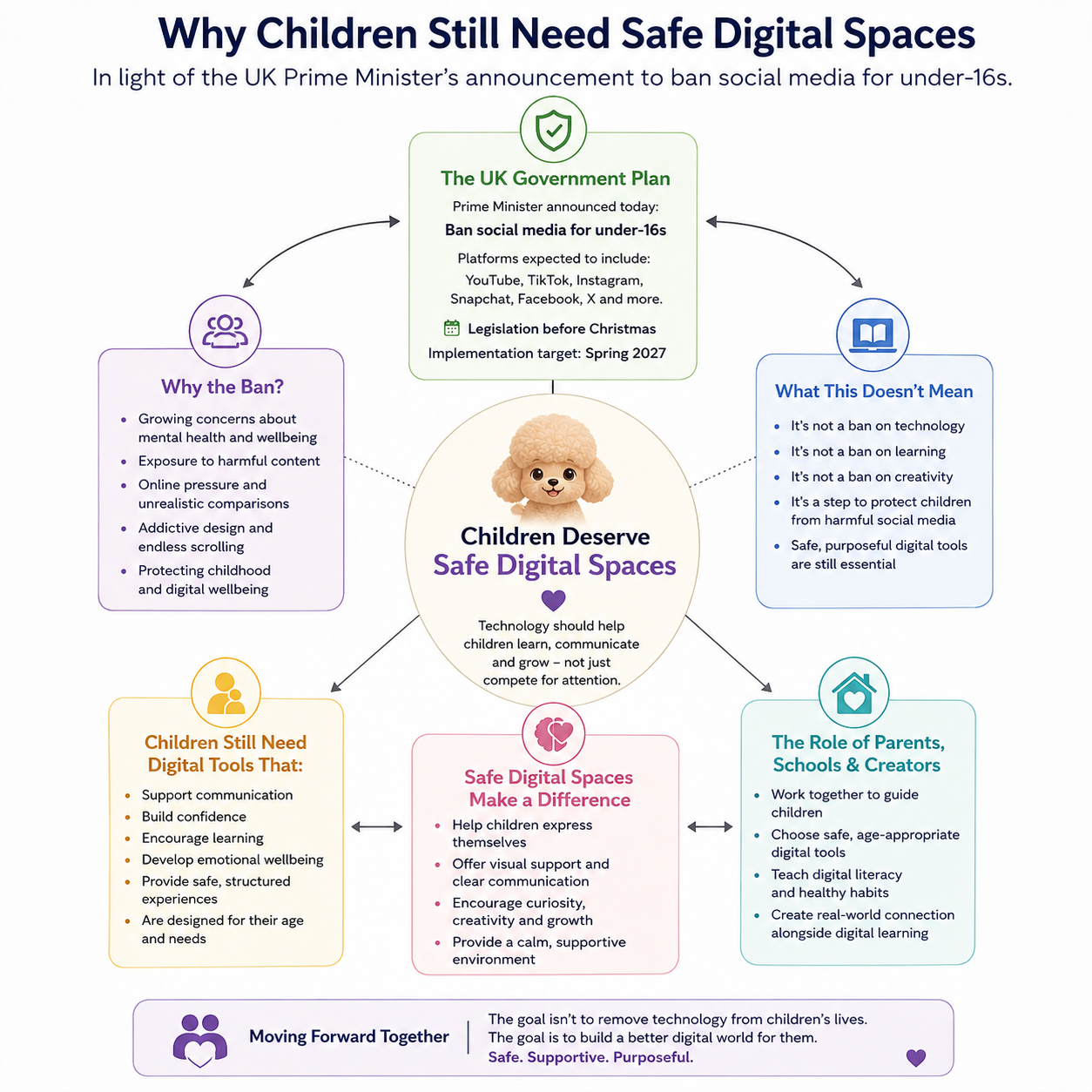
Why Children Still Need Safe Digital Spaces
A Teaching Assistant's Perspective on the UK's New Social Media Ban
Today, UK Prime Minister Keir Starmer announced plans to ban social media access for children under the age of 16, describing it as a major step towards protecting children's wellbeing online. The proposed restrictions are expected to cover major platforms including YouTube, TikTok, Instagram, Snapchat, Facebook and X.
As both a teaching assistant and the creator of Poodles & Friends, today's announcement immediately caught my attention.
And while I understand many of the concerns that have led to this decision, I believe there is an important distinction that should not be overlooked.
Not all digital spaces are the same.
There is a significant difference between platforms designed to maximise attention and platforms designed to support learning, communication and wellbeing.
Every day in schools, I meet children with different needs, different challenges and different ways of communicating. Some children struggle with confidence. Some struggle with emotional regulation. Some struggle to communicate their thoughts and feelings at all.
For these children, technology can be more than entertainment.
It can become a bridge.
The conversation should not only be about limiting harmful online experiences. It should also be about creating safe digital spaces where children can learn, communicate, create and feel supported.
At Poodles & Friends, this belief sits at the heart of everything we create.
We believe children deserve technology that helps them grow rather than simply compete for their attention.
As the national conversation continues, perhaps the question is not whether children should have access to technology.
Perhaps the question is:
What kind of digital spaces should we be building for them?
— L C
Creator of Poodles & Friends